Showing posts with label Fused Games. Show all posts

Tuesday, May 19, 2015

CHAlleNGED GAMES @ Designmonat Graz 2015 #1

CoasteredTic-tac-toe and PuzzledTic-tac-toe were shuffled!

And a beautiful mistake showed me that CHALLENGE, apart of CHANGE contains also ALL and  ALLE (ALL in German).

@

GAME CHalleNGE with veroniKATZE  


Designmonat Graz 2015/ Design in the City
May 13 | 4:00 pm
Mau Shi fusion restaurant (Herrengasse 7, 8010 Graz)


Tuesday, August 27, 2013

Fused Games: SHOGUNed Tic-tac-toe, 2013

SHOGUN is Ravensburger strategic game with element of luck published in 1979. It is played on 8x8 grid, and each player has 7 pawns and 1 Shogun. Each piece has a window, which shows a number indicating the number of moves that piece can make. There are many magnets under the board, which causes the number automatically change after each move of the pawns or the Shogun.


The SHOGUNed Tic-tac-toe, is played using the SHOGUN game board and pawns. After the different fusions with puzzles, here the tic-tac-toe fuses with another strategic game. The fused game is, playing tic-tac-toe, by using the props and rules of the Shogun game. The goal is as in the regular tic-tac-toe to make a line of three. The manner of playing is irregular, meaning that no 3x3 grid is predefined, it appears, and may also disappear, in the course of the game.
SHOGUN game set
Veronika Tzekova, SHOGUNed Tic-tac-toe, 2013
How the pieces are moved:
The number showing on the piece indicates how many squares the piece has to be moved (1 to 4 for the pawns and 1 to 2 for the Shogun). The number on the piece changes while it is being moved around the board.
The pieces can be moved only horizontally and vertically, not diagonally. In each move only one right angle is allowed.
A piece can never jump over another piece.
A piece can not be moved forwards and backwards in the same move.
Once the 3x3 tic-tac-toe grid is defined on the Shogun board the pieces can be moved only within it. When not yet defined, the pieces move in imaginary 3x3 grid.

How to capture:
Any piece can capture any of the opponent pieces by landing on the square occupied by the piece at the end of the move. The captured piece is removed from the board.

End of game:

Game is when either one of the players composes a line (winning) or when one is left without pawns (loosing).

Friday, July 5, 2013

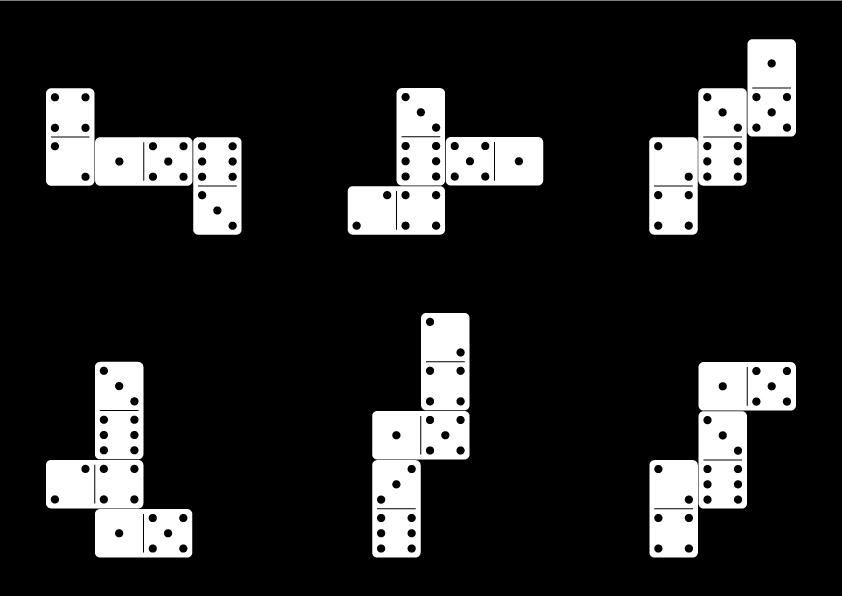
Fused Games: Dominoed Unfolded Dice, 2013


Veronika Tzekova, Dominoed Unfolded Dice, 2013

The dominoes always looked like massive deconstruction to me. Numerous fall-a-parts. Of individual dices, which partly kept their integrity, some with their pips faded away and some involved in primordially impossible combinations.
The Dominoed Unfolded Dice is actually a puzzle game fusing generic gaming devices like dominoes, dice, and playing cards. The imagination challenge is to fictionally construct a 3D object out 2D elements. The game has rules and is to be played alone or with two players. These will not follow here as my primary interest in this game post is the abstraction and construction of new integral system from the visual chaos and multiplicity of another such. Raw and refined, mathematics can be a poetry. I hope you see why because I can’t tell you.

The Dominoed Unfolded Dice set consist out of 12 tiles out of the 28 tiles of the standard double six dominoes set. The 12 ones are these that stand for possible adjacent dice walls, which leaves out the blank ended, the doubles and 1|6, 2|5 and 3|4. Keep in mind that the opposite sides of a die traditionally add up to seven, implying that the 1, 2 and 3 faces share a vertex; these faces may be placed clockwise or counterclockwise about this vertex.

The hexomino is a polygon in the plane made of six equal-sized squares connected edge-to-edge. When rotations and reflections are not considered to be distinct shapes, there are 35 different free hexominoes.

The domino is a polygon in the plane made of two equal-sized squares connected edge-to-edge. When rotations and reflections are not considered to be distinct shapes, there is only one free domino.

A polyhedral net for the cube is necessarily a hexomino, with 11 hexominoes actually being nets. If these are to be built with dominoes only 6 are feasible.

In this case the unfolded dice, the hexomino is to be drawn with dominoes. We have 12 different tiles to be arranged in different combinations of 3, so that each number of the dice (1-6) is present only once and and if folded should become a real dice. These arrangements can take 6 possible shapes. 

:) Here are some verses:


Monday, July 1, 2013

Friday, June 28, 2013

Thursday, June 27, 2013

Fused Games: LEGOed Tic-tac-toe, 2013

Veronika Tzekova, LEGOed Tic-tac-toe (1x1), 2013

Veronika Tzekova, LEGOed Tic-tac-toe (1x4), 2013

And puzzled again, this time by LEGO.

Wednesday, June 26, 2013

Fused Games: Slider Puzzled Tic-tac-toe, 2013

Veronika Tzekova, Slider Puzzled Tic-tac-toe, 2013


The familiar tic-tac-toe gets puzzled again.


The game is for two players and combines the rules and goals of the tic-tac-toe and the basics of the slider puzzle. The goal is as in the classic tic-tac-toe to arrange 3 of one’s sign in a row (vertical, horizontal, diagonal). The player who arranges the row first wins. In order to place his symbol a player can move all squares of the slider but eventually should keep the composition he started with, plus the newly added symbol. The”X” starts first placing his symbol and leaving any other “X”s or “O”s out of the 3x3 grid. The top left of the 3x3 grid is the top left of the slider.

Tuesday, June 25, 2013

Fused Games: Peg Mosaiced Tic-tac-toe, 2013

Veronika Tzekova, Peg Mosaiced Tic-tac-toe, 2013
The Peg Mosaiced Tic-tac-toe is puzzle based like the Jigsaw Puzzled Tic-tac-toe or the Rubik Cubed Tic-tac-toe. Like some other of the CHAlleNGED Tic-tac-toes the grid here is not predefined and is to be decided by the moves of the players.

Monday, June 24, 2013

Fused Games: Diced Tic-tac-toe #3, 2013


Veronika Tzekova, Diced Tic-tac-toe #3, 2013

9 cubes are arranged in 3x3 grid. Each cube has two sides indicating “X”, two indicating “O” and two empty ones. At the beginning all cubes are placed with empty side on top.
The goal is as in the classic tic-tac-toe to arrange 3 of one’s sign in a row (vertical, horizontal, diagonal). The player who arranges the row first wins.
The  Playing Cards Dice sets consists of:
    • Two sets each designed as side of the traditional six sided dice with dots from 1-6. One of the diced sets has bigger dots, one smaller dots.
    • Two aces, one indicating “X” and one indicating “O”. 
    • The players through the XO Dice to decide who is playing with the “X” and who is playing with the “O”.  Than the players play in turns with the “X”. 
The players shuffle the cards and deal those 7 to each player.
The players place cards one after each other. The “X” player places a card first at the beginning. The one with the stronger card takes both cards and makes a move. Each move consists of rotations of a single cube in a single direction equal to the sum of both cards.
If a player has the ace with its own sign can make a two moves.
If a player has the ace with the opponent sign can make a move with a cube with the sign of the opponent on the top. The aces a stronger than the cards with the dots. “X” ace beats “O” ace.
When the first seven cards are over the game continues with the cards each player collected. If a player has not collected any cards, loses the game and the game is over.


Sunday, June 23, 2013

Fused Games: Diced Tic-tac-toe #2, 2013

Veronika Tzekova, Diced Tic-tac-toe #2, 2013


As a table game tic-tac-toe often meats the coasters… the tic-tac-toe is CHAlleNGED by a CHAlleNGED dice = Diced Tic-tac-toe #2

9 cubes are arranged in 3x3 grid. Each cube has two sides indicating “X”, two indicating “O” and two empty ones. At the beginning all cubes are placed with empty side on top.


The goal is as in the classic tic-tac-toe to arrange 3 of one’s sign in a row (vertical, horizontal, diagonal). The player who arranges the row first wins.


The Coaster Dice consists of 6 coasters each designed as side of the traditional 6 sided dice with dots from 1-6. The players shuffle the coasters and deal them as cards: 3 to each player. To make a move each player pulls on of his/her coasters and rotates a cube in one direction so many times as the dots on the coaster indicate. The players deal the cards/coasters in turn when all of them are used.

Thursday, June 20, 2013

Fused Games: Diced Tic-tac-toe #1, 2013

Veronika Tzekova, Diced Tic-tac-toe #1, 2013


The familiar tic-tac-toe game, once got CHAlleNGED by getting 3D and second by fusing the original rules with rolling of a customized dice.


Nine cubes are arranged in 3x3 grid. Each cube has two sides indicating “X”, two indicating “O” and two empty ones. At the beginning all cubes are placed with empty side on top.

The XO Dice has six sides, as three are indicating “X” and three “O”.

The goal is as in the classic tic-tac-toe to arrange 3 of one’s sign in a row (vertical, horizontal, diagonal). The player who arranges the row first wins.

Players roll the dice in turns.

The first indication of the dice decides the signs with which each of the players will play. For example: player A throws, and “X” is indicated. Player A makes move when X is indicated, and player B when “O” is indicated.

Each move is only one turn of a single cube in any desired direction.
And to make the experience more versatile and offer more material for philosophical speculations on how this represents reality two version can be played.

Version I: When the opponent sign is indicated by the dice, one can move a cube with the opponent sign on top. If not skips move.

Version II: When the opponent sign is indicated by the dice, the opponent is entitled to make a move. The player is forced to play in favor of the opponent.

Monday, June 17, 2013

Tuesday, June 11, 2013

Fused Games: The Jigsawpuzzled Tic-tac-toe, 2012

Veronika Tzekova, Fused Games/ The Jigsawpuzzled Tic-tac-toe, 2012

Veronika Tzekova, Fused Games/ The Jigsawpuzzled Tic-tac-toe, 2012

Veronika Tzekova, Fused Games/ The Jigsawpuzzled Tic-tac-toe, 2012, magnetic version


Fused Games: The Rubik Cubed Tic-tac-toe , 2012

Veronika Tzekova, Fused Games/ The Rubik Cubed Tic-tac-toe, 2012


The original Rubik Cube is once hacked by making it only in three colors (2 sides each) and fused with another game by marking two sides with X’s and two with O’s and leaving two in plain color. The goal is to use one of the plain colored sides as a board to play tic-tac-toe by two players.
It is possible I tried it!(but will be politically wise to make friends with the Rubik Cube first:))

Thursday, June 6, 2013

The CHAlleNGE: Analog Gamification


The CHAlleNGED Games are object based participatory artworks, which left behind the inviolability and distant admiration of the artwork and made the audience an active part of it.


The CHAlleNGED Games fuse conceptual art and game design, employing existing structures and design objects.


The CHAlleNGED Games serve as reality representation, challenging the player to look for new possibilities and shifting his/her perspective on the status quo and daily behavior patterns.


                                           Puzzled Tic-tac-toe © Veronika Tzekova